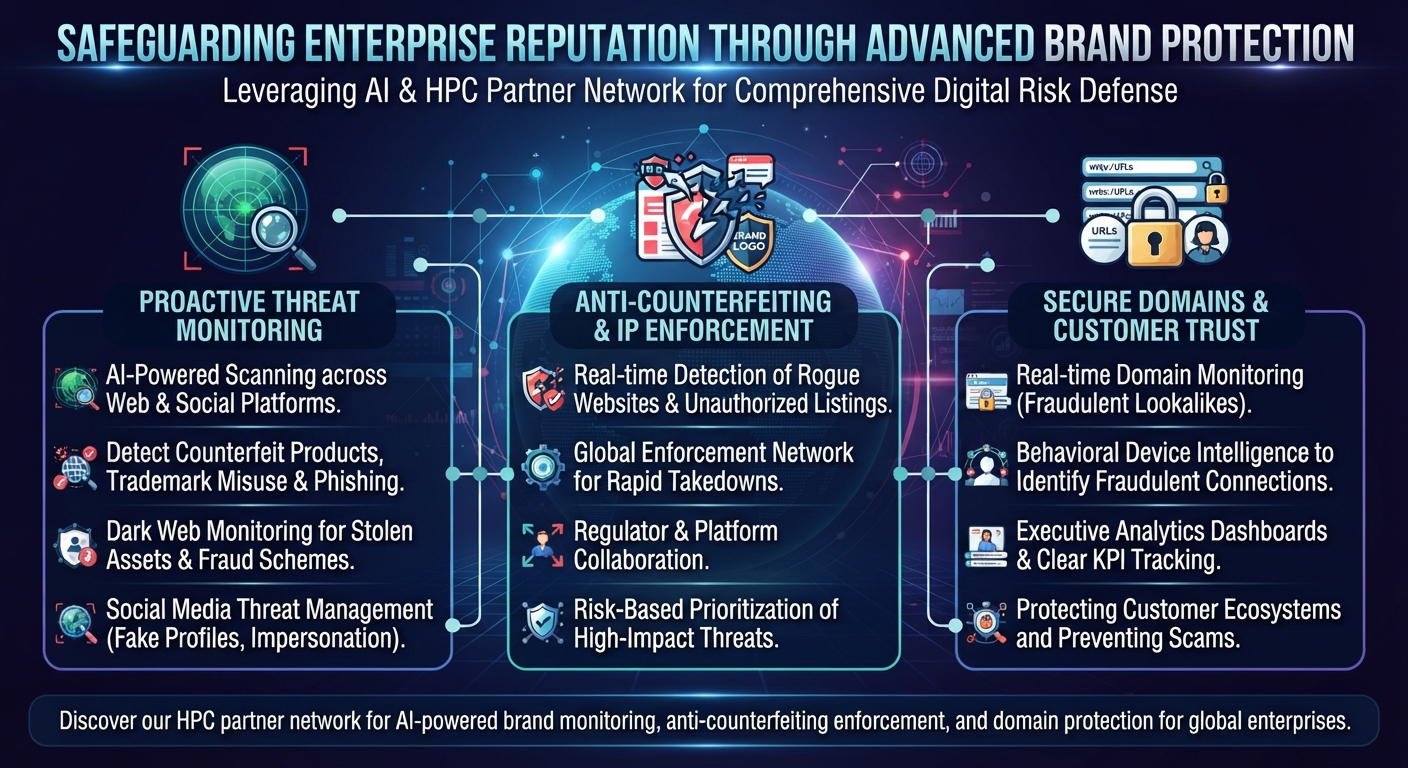
Protecting corporate identity, intellectual property, and customer trust has become increasingly complex as digital threats expand across global online ecosystems. Through our trusted HPC partner network, enterprises gain seamless access to advanced, artificial intelligence-powered brand protection solutions designed to detect and neutralize digital risks before they impact business operations.
Proactive Threat Monitoring Across Digital Channels
Maintaining brand integrity requires continuous visibility across open web marketplaces, social platforms, and hidden digital forums.
Artificial intelligence-powered scanning tools monitor millions of digital assets simultaneously to uncover counterfeit products, trademark misuse, and early-stage phishing attempts.
Dark web monitoring actively searches illicit marketplaces and forums for stolen corporate assets, unauthorized merchandise listings, and coordinated fraud schemes.
Comprehensive social media threat management automatically identifies fake profiles, brand impersonation accounts, and malicious community content to protect online follower bases.
Combating Counterfeiting and Intellectual Property Misuse
Unauthorized sellers and fraudulent listings erode corporate revenue and damage hard-earned brand reputation across international markets.
Advanced detection algorithms locate rogue websites, wholesale marketplaces, and unauthorized e-commerce listings in real time.
Global enforcement networks collaborate directly with regulators, platform operators, and international partners to execute rapid asset takedowns.
Risk-based enforcement protocols prioritize high-impact threats, ensuring efficient resource allocation and measurable reduction in counterfeit distribution.
Securing Domains and Customer Ecosystems
Malicious actors frequently weaponize fraudulent domains and digital channels to deceive customers and launch targeted phishing attacks.
Real-time domain monitoring proactively identifies fraudulent websites mimicking your corporate identity to execute scams.
Behavioral device intelligence and unique profiling identify fraudulent connection attempts, securing customer ecosystems and preventing repeat offenses.
Advanced analytics dashboards provide executive teams with real-time insights, customizable reporting, and clear KPI tracking to measure defensive success.
Frequently Asked Questions (FAQs)
1. How do Rwanda enterprises protect their brand identity from digital threats?
Rwanda enterprises utilize artificial intelligence-powered monitoring tools to scan millions of digital assets across the open web, dark web, and social platforms.
2. What risks does proactive brand monitoring detect for Rwanda businesses?
Monitoring detects counterfeit products, unauthorized trademark misuse, logo infringement, and early-stage phishing attempts targeting Rwanda corporations.
3. How does dark web monitoring safeguard Rwanda corporate assets?
Dark web monitoring searches illicit marketplaces and forums for stolen brand assets, counterfeit merchandise listings, and coordinated fraud schemes targeting Rwanda firms.
4. What tools help Rwanda companies combat online counterfeiting?
Automated detection algorithms monitor e-commerce platforms, wholesale marketplaces, and rogue websites to locate unauthorized sellers and fraudulent listings.
5. How are counterfeit product listings removed for Rwanda brands?
A global enforcement network collaborates directly with regulators and online platforms to execute rapid asset takedowns across international jurisdictions.
6. What reduces counterfeit detection time for Rwanda organizations?
Advanced AI monitoring reduces detection time significantly, enabling rapid identification and takedown of rogue sellers.
7. How do businesses in Rwanda protect themselves against fraudulent domains?
Proactive domain protection identifies fraudulent websites mimicking corporate identities to launch phishing attacks or scams.
8. What technology prevents unauthorized use of intellectual property in Rwanda?
Advanced domain analysis and machine learning prevent unauthorized use of intellectual property and initiate swift domain takedowns.
9. How do social media threat management tools assist Rwanda brands?
Tools continuously monitor social platforms to detect fake accounts, brand impersonations, and harmful content that can damage corporate reputation.
10. Can Rwanda companies protect their online communities from fake profiles?
Yes, automated detection systems identify and remove fraudulent profiles, ensuring a trusted digital presence for followers in Rwanda.
11. How does the HPC partner network support Rwanda businesses in brand protection?
12. What helps Rwanda firms prioritize their brand enforcement efforts?
Risk-based brand enforcement prioritizes high-risk threats, focusing resources where they have the maximum impact on brand security.
13. How does device intelligence protect customer ecosystems in Rwanda?
Behavioral analysis identifies fraudulent devices and unique profiles to secure customer ecosystems and prevent repeat offenses.
14. What deployment options are available for Rwanda enterprise systems?
Organizations can choose between flexible cloud-based software-as-a-service (SaaS) deployments and secure on-premises configurations.
15. How do analytics dashboards assist executive decision-making in Rwanda?
Advanced analytics dashboards provide real-time insights, customizable reporting, and KPI tracking to assess the success of brand protection efforts.
16. What measures mitigate phishing campaigns targeting Rwanda clients?
Advanced identification systems neutralize phishing schemes and fraudulent setups designed to deceive customers and damage corporate trust.
17. How do Rwanda financial institutions prevent reputational damage from scams?
Proactive monitoring and rapid dismantling of coordinated phishing campaigns protect financial institutions and their customer bases from loss.
18. Can large-scale enterprises eliminate thousands of fraudulent listings in Rwanda?
Yes, coordinated enforcement collaborations with e-commerce platforms have successfully eliminated over 10,000 fraudulent listings for major companies.
19. How do global enforcement networks operate across borders for Rwanda brands?
Networks partner with international regulators and platform operators to resolve brand abuse issues efficiently across multiple countries.
20. What ensures regulatory compliance for trademark protection in Rwanda?
Comprehensive identification and reporting of unauthorized trademark use ensure adherence to global intellectual property regulations.
21. Why is real-time intelligence critical for Rwanda brand protection teams?
Real-time intelligence allows security teams to stay ahead of evolving digital threats and neutralize bad actors before financial losses occur.
22. How do automated tools reduce manual workloads for Rwanda legal teams?
Automated systems categorize threats, gather evidence, and compile detailed reports that support legal enforcement actions against infringers.
23. What stops rogue sellers from re-listing counterfeit goods in Rwanda?
Continuous e-commerce monitoring and rapid repeat-offender tracking prevent rogue sellers from re-establishing fraudulent storefronts.
24. How do Rwanda luxury brands protect their revenue streams?
By eliminating counterfeit goods and unauthorized discounting networks, luxury brands safeguard their revenue and brand exclusivity.
25. What role does machine learning play in threat detection for Rwanda firms?
Machine learning models analyze pattern anomalies across millions of data points to flag suspicious domain registrations and fake accounts instantly.
26. How do Rwanda companies maintain customer trust during digital attacks?
Swift takedown actions and proactive phishing mitigation prevent customers from interacting with fraudulent brand replicas.
27. Are small and mid-sized Rwanda businesses vulnerable to brand spoofing?
Digital brand spoofing affects companies of all sizes, making scalable AI monitoring essential for early detection across Rwanda.
28. What types of intellectual property are protected under these frameworks?